The tour in a nutshell
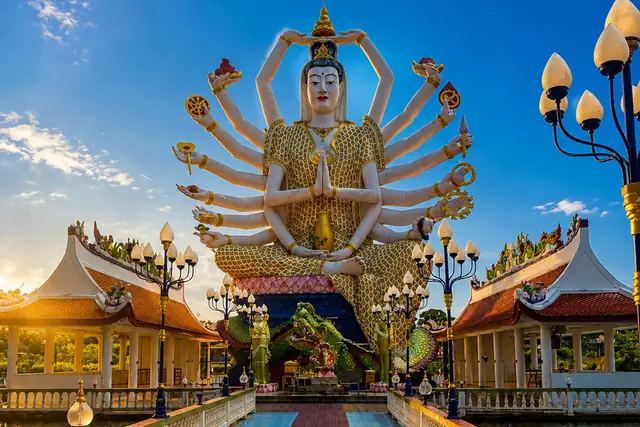
Everyone does the northern temples: the Big Buddha and Wat Plai Laem, two minutes apart, spectacular and full of coaches by ten in the morning. They are worth it. They are also a third of the story.
The south is the other two thirds, and almost nobody sells it. A monk who has been sitting in a glass case since 1973, exactly as he asked to be left. A temple carved entirely from raw red clay, still unfinished, standing on the shore. A sixteen-metre Chinese god of war looking out to sea. A golden chedi planted on the sand at the end of a lane nobody signs properly. And in the middle of it, a Muslim fishing village where the boats are still painted by hand.
It is twenty kilometres of road, five stops, and not one entrance fee. What it needs is someone who knows which turning is unmarked and what you are looking at when you get there.
Highlights
🧘
The mummified monkLuang Pho Daeng died in meditation in 1973 and asked to be left as he was. He sits at Wat Khunaram in a glass case, sunglasses on - strange, calm, and entirely serious.
🧱
The red templeWat Sila Ngu is built in unglazed terracotta, every surface carved, still unfinished after years. Red against a turquoise sea looks like nothing else on the island.
⚔️
Guan YuSixteen metres of Chinese god of war, red-faced and holding his blade, put up in 2016 by the island's Chinese community and still barely on the tourist circuit.
🌊
The golden chedi on the sandWat Laem Sor, on the far south coast: a chedi covered in golden-yellow tiles standing directly on the beach, with the strait behind it and usually nobody in it.
🐟
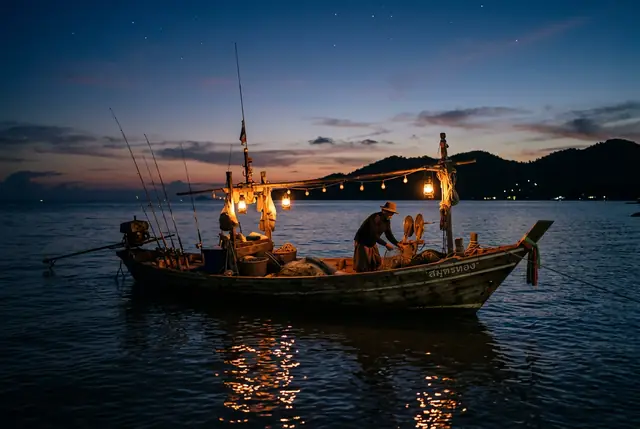
Hua ThanonA Muslim fishing village where the painted longtails are pulled up on the sand and the market is busiest before eight. The part of Samui that has changed least.
🪸
Wat SamretA seated Buddha carved from coral stone, brought here from Sri Lanka, in a temple nobody stops at. Five minutes' detour, and the quietest place on the loop.
How the day runs
- Pick-upWe collect you at your hotel, anywhere on the island. Mornings work best: the light is better and the temples are empty.
- Wat KhunaramThe mummified monk, and why he is displayed rather than buried. Ten minutes, and the one stop people talk about afterwards.
- Wat Samret & Guan YuInland to the coral-stone Buddha, then back down to the coast for the Chinese shrine and the sea view behind it.
- Hua ThanonThe fishing village: the boats, the drying racks, the covered market. Time for a coffee and something fried.
- Wat Sila Ngu & Wat Laem SorThe red temple on the shore, then the golden chedi on the sand at the southern tip - the furthest point of the loop, and the best one to finish on.
Times are indicative, the exact pick-up time depends on where you stay and is confirmed after booking.
✅ What's included
- Hotel pick-up and drop-off, anywhere on Koh Samui
- Air-conditioned vehicle and driver
- English or French speaking guide
- Water on board
- A sarong to borrow if you need one
❌ Not included
- Lunch and drinks
- Personal purchases at the market
- Gratuities
What to bring
- Shoulders and knees covered - it is a temple day
- Shoes you can slip off easily
- Cash in small notes for the market
- Sun cream and a hat
💡 Good to know
👗 Dress code: shoulders and knees covered, shoes off inside every hall. The two big northern temples lend sarongs; the small southern ones do not, so we carry a couple.
📷 At Wat Khunaram: no flash and no posing beside the case. It is a place of worship, and the monk is a body, not an exhibit.
🕌 At Hua Thanon: it is a Muslim village - dress a little more conservatively than on the beach, and ask before photographing people.
🎟️ Cost: every site on this loop is free. Donations are welcome at the temples and never demanded.
🌡️ Timing: mornings. By one in the afternoon the terracotta at Wat Sila Ngu is too hot to stand on barefoot.
Book this tour
This day is ours, not a partner's: tell us the date and how many you are, and we come back within 24 hours with the exact plan, the pick-up time and the price. A deposit confirms the booking.
Request this day 💬 Ask on WhatsApp
No online payment on this site. We answer within 24 hours, seven days a week, and the price depends on the size of your group and the vehicle.
In pictures
Frequently asked questions
Is this the same as the island tour?
No. The island and temples tour does the north and the classics - Big Buddha, Wat Plai Laem, Na Muang, Hin Ta & Hin Yai. This one goes south instead, to the temples most visitors never hear about, and takes half a day rather than a full one.
Do we have to pay to enter the temples?
No. Every site on this loop is free, including Wat Laem Sor and the Guan Yu shrine. Donation boxes exist at the temples and nobody will ask you for anything.
What should I wear?
Shoulders and knees covered, and shoes you can take off easily, you will remove them several times. We carry spare sarongs, but bringing your own is simpler. Beachwear is not acceptable at any of these sites.
Can we do this in the afternoon?
We can, but the morning is better: the light on the red temple and the golden chedi is at its best before midday, and the terracotta gets too hot to walk on barefoot in the middle of the day.
Is it suitable for children?
Yes, and the mummified monk tends to be the part they remember. It is a car day with five short stops rather than a long walk, so it works with younger children too.
📖 Read more: The southern temples: the full route · All twelve temples, mapped