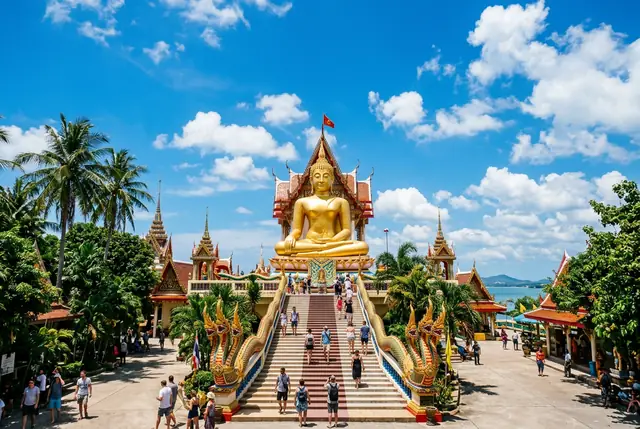
The temple circuit everybody does is the northern one: the Big Buddha and Wat Plai Laem, two minutes apart, both spectacular and both full of coaches by ten in the morning. They deserve the traffic. They are also about a third of the story. The other two thirds are in the south, they are free, and on most mornings you will have them to yourself. Here they are in the order that makes a route.
1. Wat Khunaram - the mummified monk
Luang Pho Daeng died in meditation in 1973 and asked to be left as he was, as a reminder that the body is temporary. He sits at Wat Khunaram in a glass case beside the ring road, saffron robe on, sunglasses over the eye sockets, and he has been the strangest and most serious sight on Samui ever since.
The visit takes ten minutes and costs nothing. Read the plaque before you look: what is on display is his teaching, not a curiosity. No flash, no posing beside the case, and keep your voice down - the temple around it is a working one, with a school, dogs asleep in the shade and monks going about their day.
2. Wat Samret - the coral-stone Buddha
Five minutes inland, Wat Samret holds a seated Buddha carved from coral stone and brought here from Sri Lanka. Almost nobody stops. The compound is small and functional - a modern hall, the old Buddha in a side building, plantations all around - and it is the quietest thing on this route. It is the stop that tells you what an ordinary Samui temple looks like when there is no market at the gate.
3. Hua Thanon and the Guan Yu shrine
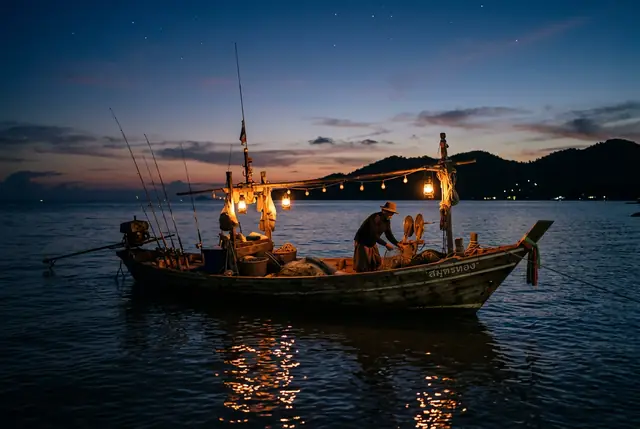
Back on the coast, Hua Thanon is a Muslim fishing village and the part of Samui that has changed least: painted longtails pulled up on the sand, drying racks in the lane behind the beach, and a covered market that is busiest before eight in the morning. Dress a little more conservatively here than on the beach, and ask before photographing people.
Five minutes away stands something entirely different: a sixteen-metre statue of Guan Yu, the Chinese god of war, red-faced and holding his blade, looking out to sea. It went up in 2016 for the island's Chinese community and is still barely on the tourist circuit. Walk around the base, the reliefs tell his story, and it takes ten minutes.
4. Wat Sila Ngu - the red temple
Wat Sila Ngu, signed as Wat Ratchathammaram, is built entirely in unglazed terracotta, every surface carved, and it stands on the shore just north of Hua Thanon. Craftsmen have been working the panels for years - scenes from the life of the Buddha, guardians, nagas - and the temple is still unfinished. Red against a turquoise sea looks like nothing else on the island.
Two practical things: the terracotta gets extremely hot underfoot around midday, and shoes come off inside the hall. Behind the main building, a golden chedi faces the water and a covered market feeds the pilgrims.
5. Wat Laem Sor - the golden chedi on the sand
The last stop is the best, and the least visited. Wat Laem Sor, on the far south coast, has a chedi covered in golden-yellow tiles standing directly on the beach, with the strait and the mainland behind it. There is a second, smaller chedi on the hill above, a few dozen steps up, with a view across to Koh Tan.
The last stretch of road is narrow and badly signed: follow the temple signs from route 4170 rather than trusting a map pin alone. Half an hour from Lamai, and usually empty.
The route, and how long it really takes
| Stop | What it is | Time | Entry |
|---|---|---|---|
| Wat Khunaram | The mummified monk | 10 min | Free |
| Wat Samret | Coral-stone Buddha, no crowd | 15 min | Free |
| Hua Thanon | Fishing village and market | 30 min | Free |
| Guan Yu shrine | 16 m Chinese god of war | 10 min | Free |
| Wat Sila Ngu | The red terracotta temple | 30 min | Free |
| Wat Laem Sor | Golden chedi on the sand | 30 min | Free |
Twenty kilometres, five temples and a market: allow four hours from Lamai, a little more from Chaweng or the north coast. Mornings are the right half of the day - the light is better, the terracotta is walkable and the fish market is still going. By one in the afternoon the south coast is hot and the market has packed up.
What to wear, and the two rules that matter
Shoulders and knees covered, shoes off inside every hall. The big northern temples lend sarongs at the entrance; the small southern ones do not, so carry one, a scarf does the job. Beachwear is not acceptable at any of these sites, and Hua Thanon, being a Muslim village, asks for a little more than the temples do.
The second rule concerns Wat Khunaram specifically: it is a place of worship and the monk is a body, not an exhibit. Photograph the temple, not the case, and never with a flash. Our wider guide to the temples of Koh Samui covers the northern sites and the etiquette in more detail.
Doing it yourself, or with us
On your own, this is an easy morning by car and a manageable one by scooter - everything is on or just off the ring road, none of it involves a hill track, and there is nothing to pay. The two things that catch people out are the unsigned turning to Wat Laem Sor and the heat on the terracotta at midday.
If you would rather have the turnings and the context handled, we run the loop as a half-day: the southern temples loop, with hotel pick-up, a guide in English or French, and spare sarongs in the car. It is priced on request because it depends on the size of your group. It is the counterpart to our full-day island and temples tour, which does the north and the classics.
What to pair it with
Three natural continuations, all on the same side of the island. Hin Ta & Hin Yai, the Grandfather and Grandmother rocks, are ten minutes from Wat Sila Ngu and best at high tide. Thong Krut, past Wat Laem Sor, is where the longtails leave for Koh Tan and Pig Island - the boats go in the morning, so it is a next-day plan rather than an afternoon one. And the hill viewpoints above Lamai - Overlap Stone, Cobra Stone - sit directly above this route, covered in our viewpoints guide.
Every temple named here is on the island map, with its coordinates, its access and the hour we would go. If you are building a full week, the multi-day itineraries fit this morning into a day that ends somewhere useful.