In Thailand, the word sanctuary is not a protected label. No ministry awards it, no independent body audits it, and nothing stops a camp that sold rides on Monday from repainting its sign as a sanctuary on Tuesday - same elephants, same chains, new vocabulary. That's why searching for an ethical elephant sanctuary in Koh Samui returns a wall of near-identical promises. This article isn't a ranking of venues. It's a checklist you can apply yourself, five minutes before you book, anywhere in Thailand.
Why we don't sell elephant rides
We're asked several times a week. Three reasons, none of them sentimental.
1. An elephant's back isn't built for it. An elephant looks like it could carry anything, and the intuition is wrong. A horse's spine is a smooth, rounded structure evolved to bear weight across the back. An elephant's carries sharp bony protrusions pointing upwards, under comparatively thin tissue and skin: the frame is built to hold its own enormous mass from underneath, not to take a vertical load from above. Sustained pressure on that ridge causes tissue damage and chronic pain - invisible from the outside, and largely irreversible.
2. The howdah weighs more than you think. The wooden riding seat is heavy before anyone climbs on. It's strapped tight around the chest and belly with ropes that chafe, worn for most of the working day, and it carries two adults plus a mahout. The harm isn't one twenty-minute ride: it's the same seat, on the same back, for years.
3. The training behind it, the phajaan. This is the part visitors never see, and it matters more than the ride. An elephant doesn't naturally accept a saddle, a hook or a crowd of strangers. The traditional method known as the crush separates a young elephant from its mother, immobilises it, and uses restraint, sleep deprivation, hunger and pain until it stops resisting human commands. An animal that has been through it stays compliant for life. The ride you're offered is the visible end of a process that happened years earlier, out of sight.
We say it plainly because you'd rather read it here than find out afterwards, and because the question lands hardest when you're travelling with children: animal encounters are what kids remember longest from a trip.
Our rule, from day one
No animal shows, no elephant riding, no feeding of wild animals on any of our tours. Small groups, local partners, and wildlife watched on the animals' terms rather than ours, the full charter is on our about page.
What an honest sanctuary looks like
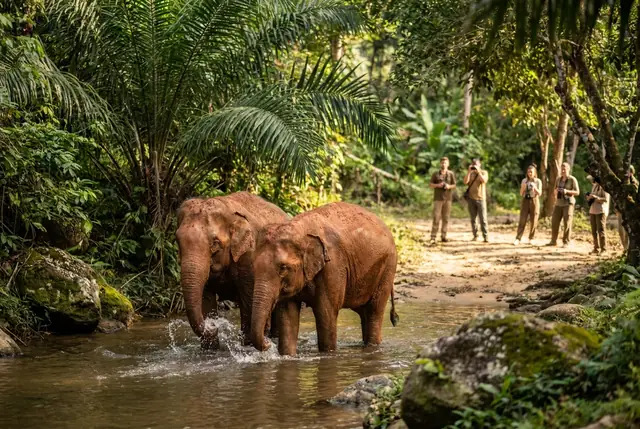
Animal-welfare organisations converge on much the same criteria, and none of them need expertise. You can check every one by phone, or by looking at the right photos.
No riding, at allNot bareback, not a short one, not just for the kids. A place that offers any riding is a riding camp, whatever the sign says.
No shows, no tricksPainting, football, bowing, balancing on a stool, posing on command: none of it is natural, and all of it was taught the same way.
Bathing on the elephant's termsThe all-day, on-demand bath is the new problem: an animal scrubbed five times a day by successive groups is performing, not bathing.
Capped numbers, real distanceFew visitors per group and per day, and elephants free to walk away. If the animal can't leave, it isn't observation.
Transparency about originsA serious place tells you where each elephant came from, one by one, and doesn't breed commercially. Babies are an attraction, and attractions create demand.
No short chains, no bullhookGood places discuss night-time restraint honestly; permanent short chaining and a hook in the handler's hand are not defensible.
The red flags, including on a website
You can rule out plenty of venues before you ever pick up the phone.
- An elephant under a marquee, on a stage or on concrete. Nothing in that setting exists for the animal.
- A baby elephant as the lead image. Babies come from somewhere: commercial breeding, or separation from a mother. Neither is a selling point.
- Unlimited photos, unlimited bathing, hugs on demand. Anything sold as unlimited is measured in the elephant's working hours.
- A saddle anywhere in the gallery, including an old photo nobody remembered to delete.
- Elephants lined up facing visitors, or fed non-stop by group after group. That's a queue, not a diet.
- A bullhook in a handler's hand, on any picture, including the ones tourists post.
- Riding packages and sanctuary packages on the same price list. The label is marketing.
The situation on Koh Samui, honestly
Several venues on and around the island present themselves as sanctuaries. Standards vary widely between them and, the part most articles skip, they change over time: owners change, managers change, an exemplary place can drift and a criticised one can genuinely improve. Any ranking published today, ours included, could be out of date by the time you read it. So we won't name or rank anyone. Here's how to check for yourself, the week you book.
Call, and ask the four questions that settle it
- Can we ride? Anything other than a flat no ends the conversation.
- Is there a show, a performance, a photo routine? Ask specifically about painting and football.
- How many visitors per group, and how many groups per day? A vague answer is still an answer.
- Where do your elephants come from, and do you breed? A place that knows its animals' histories tells you them without hesitating.
Listen to how they answer as much as to what. A serious venue has this conversation daily and replies at once, in detail, without getting defensive.
Read the reviews properly
Sort by most recent: a review from three years ago describes a different place. Search the reviews for chain, ride, show, hook and bath, and read the three-star ones rather than the extremes, that's where the detail is. Then look at the photos posted by visitors instead of the gallery on the website: unedited, taken at random moments, they show what an ordinary day really looks like, background included.
Where we stand as an agency
We don't resell any elephant activity. Not because we think no decent venue can exist, the criteria above are met by real places in Thailand, but because we only sell what we can vouch for. We know our skippers, drivers and guides personally; we can't audit a camp we don't run, on a day we're not there.
So we'd rather say it and lose the booking. If you go, go with the checklist above, and go early while it's cool. And if you want a second opinion on a particular place, write to us - we'll tell you what we know, even when we're not the ones selling.
Seeing wild animals without harming them
There's one wildlife encounter near Koh Samui we recommend without reservation, precisely because nothing about it is staged. Across the strait, in the calm bay of Khanom, lives a resident population of Indo-Pacific humpback dolphins, the ones that turn pale pink with age. You watch them from the boat, engines cut at a respectful distance: no feeding, no chasing, no swimming with them. The animals set the distance, and they often come to the boat of their own accord. Same principle as a good sanctuary, applied at sea, our full guide to the pink dolphins covers the timing.
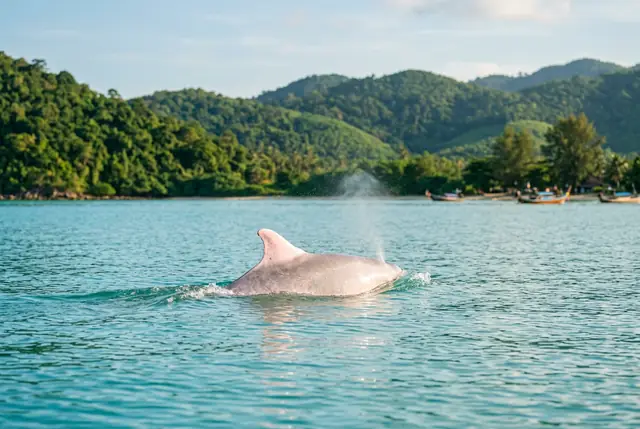
🐬 Wild dolphins, wild bay, no show
Our Pink Dolphins of Khanom day: from ฿1,800, 6–7 hours, early departure for the calmest sea, hotel pick-up included. Engines off, no feeding, no forced approach, observation in a completely natural environment.
See the tourInland, the same logic applies. On the 4x4 jungle safari (from ฿1,750, half a day) you see the island's wildlife where it lives - hornbills overhead, monkeys in the canopy, monitor lizards by the streams - with no enclosure, no feeding station and nobody performing. Add the waterfalls and viewpoints from our guide to them and you have a half-day that costs an animal nothing. For the rest of the island, start with our top 10 of Koh Samui.