Koh Samui looks small on the map - one ring road, 50 kilometres around - but how you move along that ring shapes your whole trip. Unlike Bangkok or Phuket, the island has no public bus, no metered-taxi culture and no trains: your options are songthaews, scooters, taxis and apps, or a driver. Each has a right and a wrong use. Here's the honest local rundown, prices included.
The songthaew - the island's "bus"
Those red or yellow pick-up trucks with two benches in the back are Samui's only public transport. They loop the ring road all day: you flag one down, hop in the back, press the buzzer near your stop, and pay the driver, typically 50–100 ฿ per person for hops between towns in daytime. They're cheap, breezy and very Thai, we recommend every visitor ride one at least once.
The catches: no fixed schedule, no fixed stops, routes thin out after dark, and at night some drivers quote "charter" prices closer to a taxi fare. Agree the price before you get in after sunset, and remember they follow the ring road, cross-island shortcuts aren't their thing.
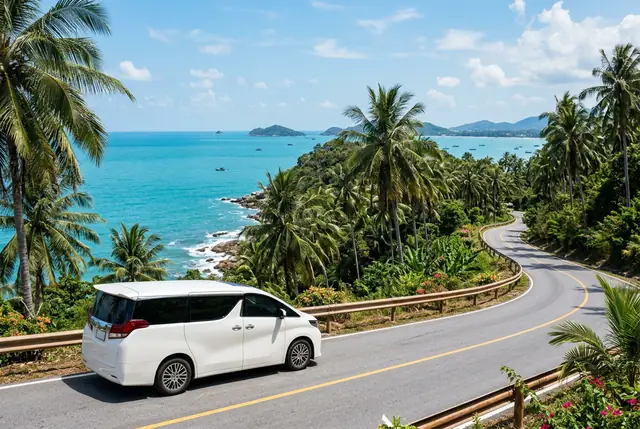
The scooter - freedom, with a serious asterisk
Renting a scooter (200–350 ฿/day) is the classic island move, and on quiet lanes at 30 km/h it's genuinely lovely. But we'd be doing you a disservice if we didn't say this plainly: Samui is one of the most dangerous places in Thailand to ride - steep hills on the west side, sudden rain on oily tarmac, sand on corners, and traffic that mixes trucks, dogs and first-time riders. Emergency rooms here treat rental-scooter injuries every single day.
If you ride anyway: you need a motorcycle licence (an IDP with the A category - without it your travel insurance will likely refuse a claim), a helmet always, long sleeves ideally, and zero alcohol. Photograph the bike from every angle before leaving the shop, and never leave your passport as deposit, cash or a copy is standard. If any of that list made you hesitate, that's your answer: skip the scooter here and ride one on a flatter, quieter island instead.
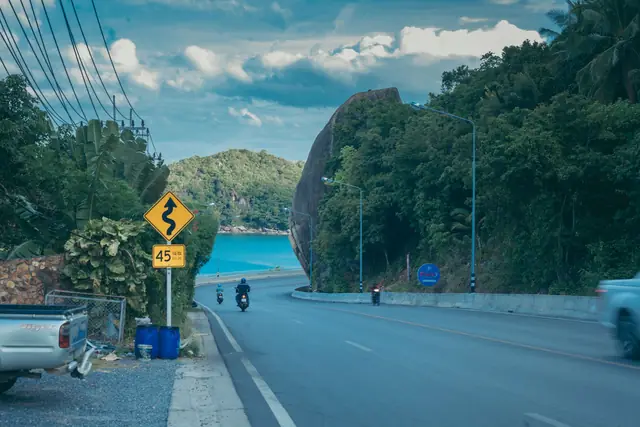
Taxis, Grab and Bolt
Samui's taxis are famous for one thing: the meter exists but is never used. Fares are negotiated, and the opening quote for tourists is often 300–500 ฿ for rides a songthaew does for 50. Your leverage is the apps: Grab and Bolt both work on Samui, with fixed upfront prices usually 30–50% below street quotes. Coverage is good around Chaweng, Bophut and Lamai, thinner on the wild south and west, plan your return ride before heading somewhere remote in the evening.
Private driver & transfers - when it's actually the smart buy
For three situations, a booked car simply wins:
- Airport arrivals and departures. After a long flight, with luggage, in the heat, haggling is the last thing you want. Our airport transfers are fixed-price per vehicle (not per person): Chaweng or Bophut 440 ฿, Maenam 550 ฿, Lamai 600 ฿, Nathon 700 ฿, the south coast 850 ฿ - flight tracked, driver waiting with a sign, up to 8 passengers.
- Ferry connections. Piers are spread around the island (Nathon, Lipa Noi, Bangrak, Maenam) and ferries don't wait. A fixed transfer from 390 ฿ takes the timing stress out.
- A day of sightseeing. If you want temples, waterfalls and viewpoints without driving, our Island & Temples day tour (from ฿1,750, lunch included) is effectively a driver, guide and itinerary in one.
Getting to the other islands
No trip stays on Samui, and the crossings are easy: ferries to Koh Phangan run all day from Bangrak and Maenam (30–60 min), and boats to Koh Tao take 1.5–2 hours. For a first taste of the neighbours, our day trips, Koh Phangan beyond the Full Moon Party and the Koh Tao & Koh Nang Yuan snorkeling day, include the crossings and hotel pick-up, which spares you the pier logistics entirely.

Our honest cheat sheet
- Short daytime hops (Chaweng ⇄ Bophut): songthaew, 50–100 ฿.
- Evenings and precise timings: Grab or Bolt, booked a few minutes ahead.
- Airport, piers, luggage days: fixed-price transfer - from 390 ฿, zero negotiation.
- Sightseeing days: a guided loop like Island & Temples beats self-driving it.
- Scooter: only with a licence, insurance, a helmet and experience - and even then, think twice in the wet season.

Paying for rides: cash, small notes and finding your way back
Most transport arguments on Samui are not really about the price. They are about change, about a driver who does not know your hotel, or about a phone that died at the wrong moment. A little preparation removes nearly all of them.
- Carry small notes. Songthaew drivers are paid in cash, at the window, and a large note for a short hop is a reliable way to start a disagreement, especially in the evening. Keep a few small notes and coins in a separate pocket, and break big notes at a 7-Eleven when you buy water.
- Let the app do the talking. Grab and Bolt show the fare before you accept, and you can usually choose between paying by card in the app or in cash to the driver. Either way, the price is settled before the car arrives, which is the whole point.
- Agree taxi fares through the window. Before you open the door, not halfway to Lamai. If the price is wrong, step back and open an app.
- Save your hotel as a map pin. Many resorts have names drivers do not recognise, and several have near-identical ones. A pin on your phone, and the hotel's business card in your wallet for when the battery is flat, will get you home from anywhere.
- Know where you are going in Thai terms. Drivers navigate by beach and village rather than by street name: "Bophut, near Fisherman's Village" works far better than a street address.
For airport and pier runs, all of this disappears: our fixed-price transfers are agreed in advance, per vehicle, with a driver who already knows where you are staying. And if you want to know how cash and cards work on the island in general, our travel info page explains how to avoid the expensive habits.
Mistakes we see on the road every week
We drive these roads every day, and the same handful of mistakes come up again and again. None of them is dramatic on its own, which is exactly why people make them.
- Trusting the navigation app's shortcut. Map apps love to send cars and scooters across the interior on the shortest line, which on Samui often means a steep concrete track or a dirt road through the jungle. Stay on the ring road unless you know the route, and read our guide to the viewpoints and the roads up before heading into the hills.
- Riding in swimwear and flip-flops. It feels natural on an island, and it turns a slow slide on sand into a trip to the clinic. Even for five minutes to the beach, wear shoes and a shirt.
- Walking the ring road at midday. Distances look short on the map, but pavements are rare, the traffic is close and the sun is fierce. A songthaew for a few kilometres is cheaper than heatstroke.
- Cutting a ferry connection too fine. A songthaew has no timetable and may detour; a missed boat costs far more than the fare you saved. Leave a margin, or book the ride.
- Assuming the evening ride home will appear. Out on the south and west coasts, cars and songthaews thin out after dark. Ask the restaurant to call a taxi, or book your return before dessert.
- Renting without checking the basics. If you do take a scooter, test the brakes, look at the tyres and make sure the helmet actually fastens before you sign anything.
Most of these come down to the same idea: Samui is small, but it is not a city, and the gaps between towns are where plans go wrong. When in doubt, send us a message before you set off.
The bottom line
Mix and match: songthaews for fun and short hops, apps for evenings, a fixed transfer whenever timing or luggage matters. And if your plans involve a specific pier, an early flight or a hotel at the end of a dirt track, message us on WhatsApp - we'll tell you honestly what the ride should cost, even when it's not one of ours.