Ask us what surprises visitors most about Koh Samui and the honest answer is: the temples. People come for beaches and boat trips, then go home talking about a golden Buddha in the morning light or a garden of statues hidden in the jungle. Samui's temples are free or nearly free, genuinely active places of worship, and most sit right on the ring road you'll drive anyway. Here are the five worth planning around, in the order we'd visit them.
1. Big Buddha (Wat Phra Yai) - the icon
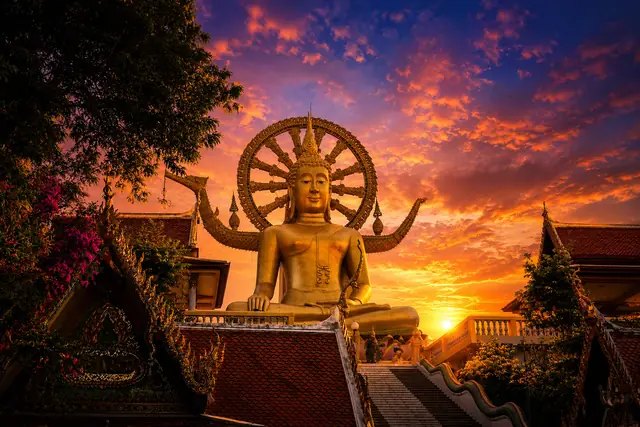
Twelve metres of gold-covered serenity sitting on its own islet off the north-east coast, reached by a short causeway. Built in 1972, the Big Buddha is the image most people carry of Samui before they even land, your plane window will probably frame it on approach. Climb the naga staircase, walk the terrace for a 360° view over the bay, and come before 10 am: soft light, few tour groups, and the resident monks going about their morning routine. Entry is free; a small donation is appreciated.
2. Wat Plai Laem - the spectacular neighbour
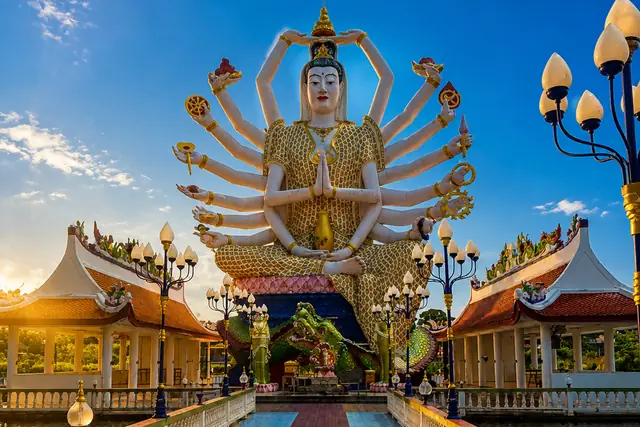
Five minutes down the road and skipped by far too many people. Wat Plai Laem is the most visually striking temple on the island: an 18-arm statue of Guanyin, goddess of mercy and compassion, rises from a lake alive with fish, surrounded by pavilions that mix Thai and Chinese styles in colours you won't quite believe until you're standing there. Buy a bag of fish food for a few baht, find the enormous laughing Buddha across the water, and give this place more time than you think it needs.
3. Wat Khunaram - the mummified monk
On the southern ring road, Wat Khunaram holds one of Thailand's most curious sights: the body of Luang Pho Daeng, a monk who died in meditation in 1973 and whose remains sit upright in a glass case, remarkably preserved, and famously fitted with sunglasses. It sounds macabre; in person it's oddly peaceful. Thais visit as a lesson in impermanence, exactly as the monk himself requested before his death. Entry is free; keep voices low and dress respectfully.
4. Laem Sor Pagoda - golden, seaside, silent
At the island's far southern tip, a chedi covered in golden tiles stands directly on the shoreline with nothing but sea behind it. Hardly anyone makes the detour, which is precisely its magic: you'll often have the whole gleaming courtyard to yourself, with the sound of waves for company. Pair it with the quiet beaches of the south coast, and if you're there late in the day, the low sun on the gold is something special.
5. The Secret Buddha Garden - statues in the jungle
High in Samui's mountainous interior, a durian farmer named Nim Thongsuk began filling his land with statues in 1976, at the age of 77, and kept going for years. The result is somewhere between a temple, a sculpture park and a fairy tale: figures of deities, animals and musicians scattered among boulders, streams and jungle shade. The catch is the road up, which is steep, rough and genuinely 4x4-only - one reason the garden is a signature stop on our 4x4 jungle safari (from ฿1,700), along with viewpoints and waterfalls. Entry is around ฿80.
Temple etiquette in 60 seconds
- Cover shoulders and knees. A sarong in the day bag solves everything.
- Shoes off before entering any building, follow the pile of flip-flops.
- Mind your feet: never point your soles at a Buddha image, and step over thresholds, not on them.
- Photos are fine almost everywhere - but no flash near people praying, and never pose climbing on a statue.
- Donations, not tickets, keep most temples open. A few coins in the box is plenty.
Seeing them all in one easy day
Big Buddha, Wat Plai Laem and Wat Khunaram string neatly along the ring road, which is why they anchor our Island & Temples tour (from ฿1,750) - the classic circuit with viewpoints, waterfalls and lunch handled, and a guide who can actually explain what you're looking at. Prefer your own rhythm? A private driver lets you linger where it clicks. Either way, start early: heat and crowds both peak after 11 am.
Reading a Thai temple: the symbols worth knowing
You can enjoy Samui's temples as pure scenery, but ten minutes of vocabulary turns a pretty stop into something you can actually read. These are the shapes and objects you will meet at almost every temple on the island, the big ones and the village ones alike.
- Naga. The serpents whose bodies form the staircase rails at the Big Buddha and on countless temple steps. In Thai Buddhism they are protectors of water and of the Buddha himself; climbing between two of them is a way of entering a guarded space.
- Chedi. The bell-shaped tower, like the golden one at Laem Sor. It is a reliquary, built to hold relics or sacred objects, and you walk around it clockwise, keeping it on your right.
- Ubosot, or bot. The ordination hall, the most sacred building in a temple. Look for small carved boundary stones, the sema, set around it: they mark the consecrated ground.
- Chofa. The slender, hooked finials curling up from the ends of temple roofs. Often read as a stylised bird or naga, they are the detail that makes a Thai roof instantly recognisable.
- Hand positions. Every Buddha image is making a gesture. A right hand reaching down to touch the ground recalls the moment the Buddha called the earth to witness his enlightenment; a raised open palm means reassurance, a dispelling of fear.
- The weekday Buddhas. At many temples you will see a row of small statues in different postures. Thais associate one with each day of the week, and people make offerings at the one for the day they were born.
- Gold leaf. Those flaking golden patches on smaller statues are tiny squares of gold pressed on by worshippers as an act of merit.
Wat Plai Laem adds a Chinese layer to all this, with Guanyin and the laughing Buddha, which is why it looks so different from its neighbours. If you would rather have someone point these things out as you go, it is exactly what the guide on our Island & Temples tour does, and the southern temples are the place to practise on your own.
Monks, offerings and making merit
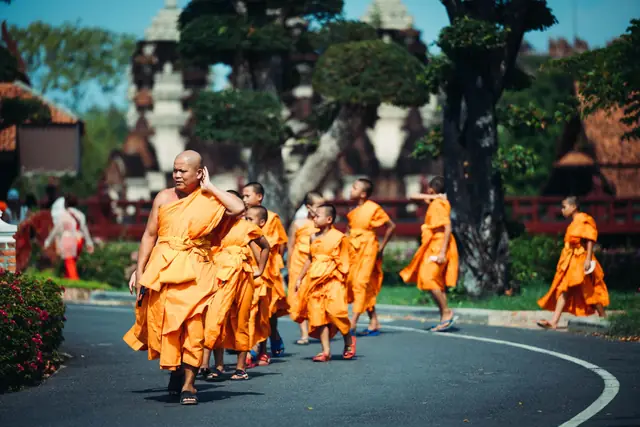
Samui's temples are homes before they are sights: the monks you pass in saffron robes live, study and work there. A few points of courtesy go a long way, and most visitors simply do not know them.
- Women do not touch a monk, brush against his robe or hand him anything directly. If you want to give something, place it on a cloth or a table in front of him, or let a man pass it on. Monks will step aside for you on a narrow path; do the same for them.
- Stay lower, not higher. If a monk is seated, sit down too rather than standing over him, and never sit on a raised platform reserved for monks.
- A wai, not a handshake. Palms together at chest height, a slight bow. Do not expect a monk to return it: that is normal, not rudeness.
- Ask before a portrait. A wide shot of a temple with monks in it is fine; a close-up of a face is a request, not a right.
If you would like to take part rather than just watch, it is simple and welcome. Most temples have a stand selling a small set of a lotus bud, incense sticks and a candle for a few baht: light the candle and incense, hold the lotus between your palms, kneel, bow three times and place your offering. Many temples also keep a pot of fortune sticks, which you shake until one falls out and then match its number to a printed slip. And a coin in the donation box is the most useful merit of all, since it is what keeps the place running.
Early mornings are when monks walk their alms rounds through the villages. If you happen to see one, stay quiet and at a distance; it is a daily ritual, not a performance laid on for photographs. Travelling with a private driver makes it easy to stop at small village temples where none of this is staged.
Book it online
Half-day island tour with transfers
Five hours around Samui with hotel transfers: Big Buddha, Wat Plai Laem, the Lad Koh viewpoint, the Hin Ta & Hin Yai rocks and the Guan Yu shrine. Rated 4.6/5 by 532 travellers. from ฿720 / person
See availability on GetYourGuide →
Booked through our partner GetYourGuide: live availability, instant confirmation.
The bottom line
You don't need to be religious, or even mildly spiritual, for Samui's temples to work on you. They're the island's memory, its art gallery and its quietest corners rolled into one, and they cost next to nothing. Two hours and a sarong are all it takes; there's a good chance they end up a highlight of the whole trip.