Ask the internet how to get to Koh Samui and you mostly get booking widgets and a cheerful "just fly to Samui!" - which happens to be the most expensive way to do it. The island has no bridge and no railway station: every arrival is a flight, a boat, or both, and the combination you pick can move your travel budget by a factor of three. Here's the version we give friends, written from the island, with the trade-offs left in.
The three ways to get to Koh Samui
Strip out the marketing and there are three families of routes. Everything else - joint tickets, night buses, "VIP transfers" - is a variation on one of them.
Fly straight inLand at Koh Samui airport (USM), be at your hotel 20 minutes later. Fastest, and clearly the priciest.
Mainland flight + ferrySurat Thani or Nakhon Si Thammarat, a van to the pier, a boat across. Half the price or better.
Boat from a neighbourAlready on Koh Phangan, Koh Tao or the Chumphon coast? You're 30 minutes to 2.5 hours away.
1. A direct flight to Samui airport (USM)
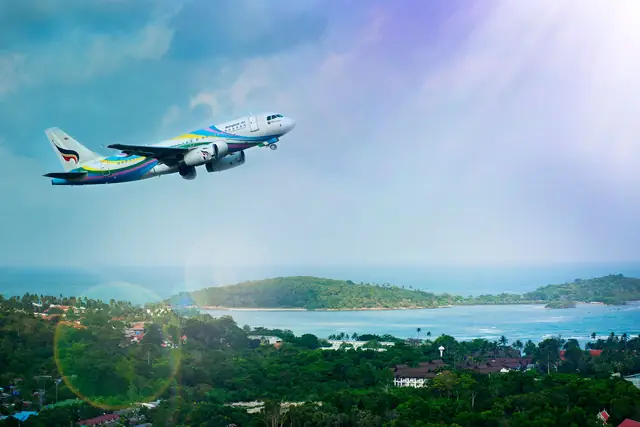
The Bangkok to Koh Samui flight is the backbone of the island's tourism: about an hour in the air from Suvarnabhumi, with departures spread through the day. Bangkok Airways owns the airport and flies most of the schedule, Thai Airways also serves the route, and other carriers have come and gone over the years, so re-check which airlines fly from Bangkok to Koh Samui in your season. Domestic connections from Chiang Mai, Phuket and U-Tapao exist too, plus a few seasonal regional routes (Singapore, Kuala Lumpur, Hong Kong).
2. Fly to Surat Thani or Nakhon Si Thammarat, then van and ferry
The route the budget airlines opened up, and the one most long-stay travellers use. You fly to Surat Thani (URT) or Nakhon Si Thammarat (NST), both served by Thailand's low-cost carriers mostly out of Don Mueang, then buy a joint ticket bundling the minibus to Donsak pier and the crossing. Sold in the arrivals hall, not glamorous, and it works.
3. A ferry from a neighbouring island
If you're already island-hopping in the Gulf, Samui is the hub: catamarans and car ferries link it to Koh Phangan (30 to 60 minutes), Koh Tao (roughly 1.5 to 2.5 hours, usually via Phangan) and Chumphon on the mainland coast.
Side by side: the honest comparison
Door-to-door means bag-drop in Bangkok to key in hand at your hotel, not the flight time the airline quotes.
| Option | Door-to-door | Price order | Who it suits |
|---|---|---|---|
| Bangkok → Samui, direct flight | 3–4 h | Highest | Short trips, families with toddlers, tight schedules |
| Bangkok → Surat Thani + van + ferry | 6–9 h | A third to a half of the direct fare | Budget travellers, long stays, morning arrivals |
| Night bus or sleeper train from Bangkok + ferry | 12–15 h | Lowest | Backpackers, people who sleep well in motion |
| Phuket or Krabi → Samui, direct flight | 2–3 h | High | Andaman-to-Gulf hops with no day to lose |
| Phuket or Krabi → Samui, bus + ferry | 7–10 h | Low | Crossing the isthmus slowly |
| Koh Phangan or Koh Tao → Samui, boat | 0.5–3 h | Low | Island hoppers already in the Gulf |
At the time of writing a Bangkok–Samui flight runs into the thousands of baht one way and stays there even off-season, while the Surat Thani combo lands well under half that. Fares move constantly: treat these as orders of magnitude, not quotes.

Koh Samui airport (USM): the garden terminal, and what it costs you
Samui's airport is unlike any other in Thailand: privately owned and operated by Bangkok Airways, and built like a resort - open-sided thatched pavilions, no jet bridges, buggies ferrying you from the aircraft steps to a check-in hall with a breeze running through it. Bags come out fast, and you can be in a car ten minutes after landing.
The flip side is structural. A private airport sets its own landing fees, those fees are high, the runway is short and sized for regional jets, and few airlines find the route worth flying. Little competition means fares stay stubbornly expensive, including last minute - "book late and save" doesn't apply here. That's the whole reason the mainland combo exists. One consolation: USM sits between Chaweng and Bophut, so most beach hotels are 10 to 30 minutes away.
The smart combo: fly to Surat Thani, then take the ferry
The arithmetic, honestly. A budget flight to Surat Thani plus a joint van-and-ferry ticket usually costs a fraction of the direct fare - for a family of four, that gap is two or three excursions. What you pay instead is time: six to nine hours from Bangkok against three or four flying direct, part of it on a minibus with your knees against the seat in front.
It's the right call for stays of two weeks or more, for groups, and for anyone landing in Bangkok in the morning. It's the wrong call when you land late: the last crossings leave the mainland in the evening, so a night arrival at Surat Thani means a hotel there and a fresh start tomorrow, which erases the saving. In doubt, be at Donsak by mid-afternoon. The same combo works overland: night buses and the sleeper train from Bangkok feed the same ferries, cheapest of all and slowest of all.
Samui's five piers, explained
Nothing confuses arrivals more than the piers. Samui has five in regular use, spread around the island, and it's your ticket, not your hotel, that decides which one you need.
Nathon - the mainland gateway
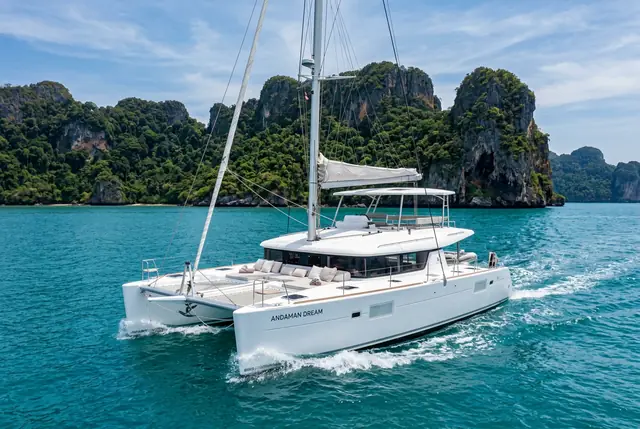
The old administrative town on the west coast, facing the mainland. Seatran's car ferries from Donsak dock here, along with the slower express boats from Surat Thani town, so a joint ticket often lands you at Nathon. Several Ang Thong Marine Park boats leave from here too, and the park closes from 1 November to 15 December each year.
Lipa Noi - the other car ferry
A few kilometres south of Nathon, Lipa Noi is the Raja Ferry terminal for the Donsak crossing. Same route, different company, different pier, and usually where you're sent if you're bringing a car or a motorbike over.
Bangrak (Big Buddha pier) - fast boats north
On the northeast corner, beside the Big Buddha temple and ten minutes from the airport. This is the fast-boat pier: services to Koh Phangan, including the direct run to Haad Rin, and connections onward to Koh Tao. It's also the closest pier to Chaweng and Bophut.
Maenam - the catamaran pier
On the north coast, the main base for the high-speed catamarans running Samui–Koh Phangan–Koh Tao–Chumphon. Operators shuffle between Maenam and Bangrak by service and season, so read the pier name on your ticket rather than assuming.
Pralarn - the small one
A modest northeast pier used mainly by speedboats: day-trip departures and some private island transfers. You won't arrive here from the mainland, but you may well leave from it.
The piers are scattered and boats don't wait, so this is one of the few moments on Samui where a fixed price beats improvising, our pier transfers start at ฿390 per vehicle. For everything else, our guide to getting around Koh Samui covers songthaews, scooters and apps.

From Phuket, Krabi, Koh Tao and Koh Phangan
Phuket to Koh Samui catches people out: the islands sit on opposite coasts of the peninsula - Andaman one side, Gulf of Thailand the other - so there is no direct ferry, whatever a search result implies. You fly (about an hour, seasonal) or cross the isthmus by bus and take the Donsak ferry: a full day. Krabi to Koh Samui works the same way, with a joint bus-and-ferry ticket via Donsak in seven to ten hours.
Koh Samui to Koh Tao is the classic Gulf crossing - catamaran, typically 1.5 to 2.5 hours, usually via Koh Phangan. Comfortable in the calm months, genuinely rough when the northeast monsoon blows, which is worth weighing when you choose when to visit. Koh Phangan is the easy one: 30 minutes to an hour, boats all day, several piers at both ends.
If the neighbours are a day out rather than a destination, the excursion format removes the problem: our Koh Tao & Koh Nang Yuan day trip (from ฿4,085) and Koh Phangan Discovery (from ฿2,500) include the crossing, the hotel pick-up and the return - no pier logistics, no ticket queue, no wondering which boat comes back last.
Coming from Europe: Paris, Marseille, London
The thing nobody says plainly: there is no direct flight from Europe to Koh Samui, and there won't be - the runway is built for regional jets, not long-haul aircraft. Every European itinerary routes through Bangkok. Paris has direct Bangkok services (11 to 12 hours), the simplest starting point; Marseille and the French regions connect via Paris, Amsterdam or a Gulf hub, often cheaper anyway; London has direct flights plus the full range of one-stop carriers.
From Bangkok you face the same choice as everyone, with one trap. Connecting to Samui keeps you at Suvarnabhumi - leave three hours at least, and remember a separately booked domestic ticket means collecting your bags and checking in again. The budget route to Surat Thani mostly leaves from Don Mueang, the other airport, an hour across the city: allow four to five hours. When a connection looks tight, a night in Bangkok is cheaper than a missed flight.
You've landed. Now what?
Samui's arrivals hall has taxi desks but no meters, and the opening quote for a short hop can be three times what the ride is worth, at the exact moment you have the least energy to argue. Booking the last leg in advance is the one bit of pre-planning we'd insist on, and it costs less than the haggled fare.
🚐 Airport and pier transfers, fixed price
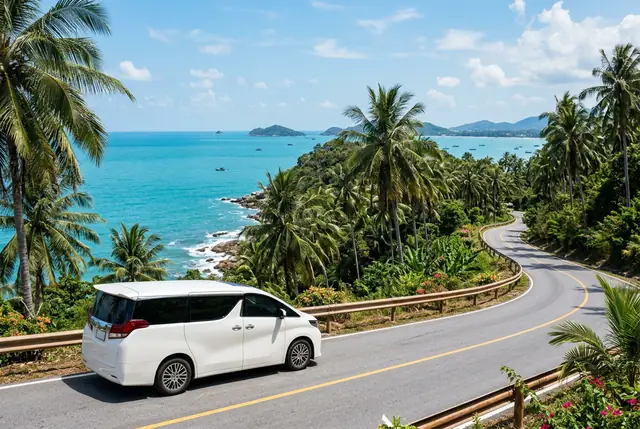
Prices are per vehicle, not per person, for up to 8 passengers: Chaweng and Bophut / Fisherman's Village ฿440 (10–15 min), Maenam ฿550, Lamai ฿600, Nathon ฿700, Taling Ngam and the south coast ฿850. Transfers to any pier start at ฿390. We track your flight, so a delay costs you nothing, and your driver waits in arrivals with a sign and your name on it.
See transfer pricesYour first hour in Thailand: arrival card, phone and cash
Whichever route you choose, the same three small jobs wait for you between the plane and the beach, and they go much faster if you have thought about them before you leave home.
- The arrival card, before you fly. Thailand's digital arrival card, the TDAC, is filled in online in the few days before you land, and it is free. You do it once, for your entry into Thailand, usually in Bangkok, not again for the domestic leg to Samui. Any website asking you to pay for it is a reseller.
- A phone that works from the first minute. You will need data for the transfer driver's message, a Grab, or the van company's pick-up point. An eSIM bought before you fly is the easiest option. Otherwise, SIM counters sit in the arrivals area of the airports, including Samui, and they will ask for your passport, since every Thai SIM is registered to an identity.
- Some baht in your pocket. The mainland combo is a cash-friendly journey: snacks at the pier, a tip for the porter, a songthaew at the other end. Withdraw once, a decent amount, rather than several small sums, and refuse when the machine offers to charge you in your home currency. The exchange counters in the arrivals halls are convenient rather than generous, so change only what you need for the first day.
Keep your passport, your phone, a charger and your hotel's address together in the bag you carry, not in the suitcase. On the van-and-ferry route especially, the big bags go into a pile or a hold, and you will want those four things in your hand at every step.
Our entry rules and SIM and eSIM notes are kept up to date, and they are worth a last look the week before you travel.
Luggage, seasickness and the small things that catch people out
Routes and piers are the big decisions. The trip itself tends to go wrong on smaller details, and they are easy to avoid once you know them.
- Check the bag allowance on the cheap flight. The low-cost carriers to Surat Thani and Nakhon Si Thammarat often price checked luggage separately, and a suitcase added at the airport can eat a good part of the saving. Compare the total, not the headline fare.
- Pack for the ferry, not just the plane. On the car ferries and catamarans, suitcases are stacked together and handled quickly. A soft bag or a sturdy case survives better than a fragile one, and anything valuable stays with you.
- Keep your joint ticket within reach. The van-and-ferry ticket usually comes with a sticker or a stub that staff check at each change. Losing it mid-journey is a long conversation you do not want to have.
- Buy tickets at a counter, not from a stranger. Buy from the official desks in the arrivals hall or at the pier. If someone tells you the boat is cancelled and offers an alternative, check at the desk first.
- Take seasickness seriously on the longer crossings. The Donsak ferry is usually gentle, but the catamaran to Koh Tao can be rough when the north-east monsoon blows. Take a tablet before boarding, sit low and in the middle, and look at the horizon rather than your phone.
- Bring water and a layer. Vans and boat cabins are often air-conditioned to the point of cold, while the pier in the sun is the opposite.
If your dates fall in the windy months, read how the rainy season really behaves before booking a long crossing, and have a look at the getting around guide for the ride from the pier to your hotel.
Our bottom line
Short trip, or travelling with small children and a lot of luggage? Fly direct and don't overthink it. Two weeks or more, or four of you sharing the bill? Fly to Surat Thani, take the ferry, spend the difference on the water. Already in the Gulf? Take the boat, the island seen from the deck beats any airport.
After that, where you base yourself matters far more than which pier you land at, and our travel info page covers visas, money and packing. If your itinerary has an awkward connection in it, message us on WhatsApp - we'll tell you straight whether it works, even when there's nothing in it for us.