Ask ten people what the best beach in Koh Samui is and you get ten answers, most of them right. Samui doesn't have one great beach; it has a dozen or so good ones, and they are genuinely different - sand, water depth, noise at 11 pm, the price of a room. Choosing your beach is really choosing what your holiday feels like. So instead of another top 10, here is what we actually tell people who write to us: how the coasts work, what each beach is honestly like, and a table that turns "what I want" into "go here".
The island's geography in one minute
Samui is almost a circle, about 25 km across, with a single ring road around it. Every beach you'll read about sits on that ring, and the island splits into four coasts with four characters.
East - Chaweng, LamaiWhite sand and action: the best swimming, the most restaurants and nightlife, by far the most people.
North - Choeng Mon, Bophut, Bangrak, MaenamCalm shallow bays facing Koh Phangan. Families, couples, walkable villages, sunsets sideways across the water.
West - Nathon, Lipa NoiVery quiet, very shallow, and the only side that faces the sunset. Almost no tourist infrastructure.
South - Taling Ngam, Thong Krut, Bang KaoThe wild end: coconut plantations, fishing piers and views over the Five Islands.
Distances are short but slow - count 45 minutes from Chaweng to the west coast, so read getting around Koh Samui before assuming you'll hop between beaches. Airport transfers map the geography nicely: ฿440 to Chaweng or Bophut, ฿600 to Lamai, ฿850 to Taling Ngam (full grid here); and if the trip isn't booked yet, start with how to get to Koh Samui. One thing your choice doesn't decide: all our day tours include free hotel pick-up from every beach on the island - so pick your base for how you want to sleep and eat, not for what you want to do.
The thirteen beaches, one by one
Chaweng - the main event
Six kilometres of the whitest sand on the island, and the only place where something is happening at every hour. The water is clear and swimmable, with a sheltered shallow lagoon at the northern end. Behind the sand: hundreds of restaurants, malls and bars. For: first-timers who want everything within walking distance, and anyone travelling to go out. The honest downside: loud, built up and busy, the beach road jams every evening and jet skis chew up the middle section.
Chaweng Noi - same sand, half the noise
Just south over the headland: the same fine white sand, a fraction of the crowd. It shelves more steeply, so it's better for swimming than for toddler paddling, and nearly all the frontage is resort-owned, which is what keeps it quiet. For: couples who want Chaweng's beach without Chaweng's soundtrack. The honest downside: almost no independent restaurants, dinner means a taxi or your hotel.
Coral Cove - the one you swim in with a mask
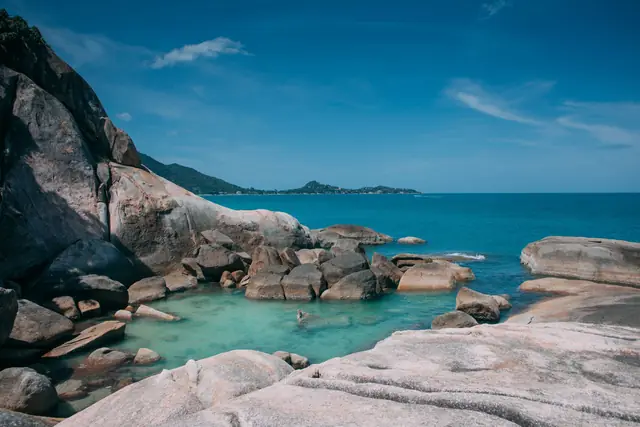
Between Chaweng Noi and Silver Beach the road climbs over a headland, and a flight of steps drops to Coral Cove: more granite than sand, which is exactly the point. The coral starts a few metres out, in water shallow enough to see everything without a boat - the easiest snorkeling on Samui that doesn't involve a day trip. The cliff restaurants above it have the best lunch view on the east coast. For: snorkelers, and anyone who would rather look at a reef than lie on sand. The honest downside: it only works at high tide - at low water the entry over the rocks is awkward and the coral sits too close to the surface to pass over without damaging it. Reef shoes, not flip-flops.
Silver Beach (Thong Ta Kian) - the postcard cove
A 200-metre pocket of sand between two granite headlands, halfway to Lamai. The clearest water on the east coast, and the rocks at either end hold enough fish for a real mask-and-snorkel swim on a calm day. For: a half-day beach stop, or a lazy snorkel. The honest downside: tiny, and no secret - after 10 am in high season it's sunbeds end to end, with nowhere to park.
Lamai - the value alternative
Samui's second beach: four kilometres of white sand, granite boulders at the southern end, and a town behind it that does everything Chaweng does for noticeably less. It shelves more steeply - good swimming, but a real shore break as soon as there's wind. For: beach, restaurants and nightlife on a smaller budget; long stays. The honest downside: the nightlife strip is beer-bar territory and feels seedier than Chaweng's, and several sections are rocky rather than swimmable.
Choeng Mon - the family bay
A sheltered horseshoe bay in the north-east corner: soft sand, water that stays waist-deep a long way out, and a small island you can wade to at low tide. It's the beach we recommend most often to parents of young children, the rest of the logistics is in our Koh Samui with kids guide. For: toddlers, nervous swimmers, anyone who wants flat water. The honest downside: a handful of restaurants and nothing else; you'll drive to Chaweng (15 min) for variety.
Bophut - the one with a village
The north coast's social centre. The beach is honest rather than spectacular: golden-brown, slightly coarse sand, calm shallow water, longtails moored offshore. What makes Bophut is Fisherman's Village behind it - an old shophouse street of restaurants and bars, with a busy Friday night market. For: walking to dinner, couples, anyone travelling without a scooter. The honest downside: not a beach you'll spend the day on, and at low tide swimming is barely worth changing for.
Bangrak (Big Buddha Beach) - convenience, not swimming
The strip beside the Big Buddha temple and the pier for Koh Phangan boats: cheap, local, unbeatable for the airport and early ferries, with good Thai food. For: a first or last night, a tight budget, an early boat. The honest downside: this is a working shoreline - shallow murky water at low tide, constant boat traffic, planes passing low overhead. Stay here for the logistics, not the sea.
Maenam - the long quiet one
Five kilometres of gently sloping golden sand under coconut palms, backed by a small town development forgot. Calm water, slightly coarser sand than the east coast, and the best room-per-baht ratio on the island. For: long stays, small budgets, families who want quiet without isolation. The honest downside: clarity varies with the tide and there are patches of seagrass; nightlife is two streets.
Bang Por - the seafood beach
Carry on west past Maenam and the north coast empties out. Bang Por is a shallow, glassy bay where islanders come to eat fish: a row of open-sided restaurants built on stilts over the water, the best-value seafood on the island, at a table with the sea underneath it. The sand itself is quiet - a few small hotels, no beach service, no beach club - and because the bay curls onto the north-west corner, the sun goes down over open water instead of behind a hill. For: a long lunch, a sunset without crossing the island, anyone who likes an empty beach. The honest downside: swimming really only works at high tide; when it drops, the flats run out a hundred metres and the water stays knee-deep.
Lipa Noi - flat, shallow, facing west
The west coast's headline beach: a long, flat strip where the sea is often as still as a lake. The tidal range is the biggest on the island, the water pulls far out and comes back bath-warm, and it faces due west, so the sun sets straight ahead of you. For: small children, floating rather than swimming, sunset people. The honest downside: at low tide you can walk a hundred metres and still be knee-deep, there's little to do, and Chaweng is 45 minutes away.
Taling Ngam - the wild south-west
The quietest coastline on Samui, looking straight at the Five Islands: small stretches of sand between rocky sections, mostly in front of a few resorts, with coconut hills rising behind. Boats to Koh Tan and Koh Madsum leave from this side. For: honeymoons, silence, anyone with a car. The honest downside: you need that car - restaurants are scarce, some stretches are rocky and shallow, and Chaweng is an hour away.
Thong Krut and Bang Kao - the south coast, boats included
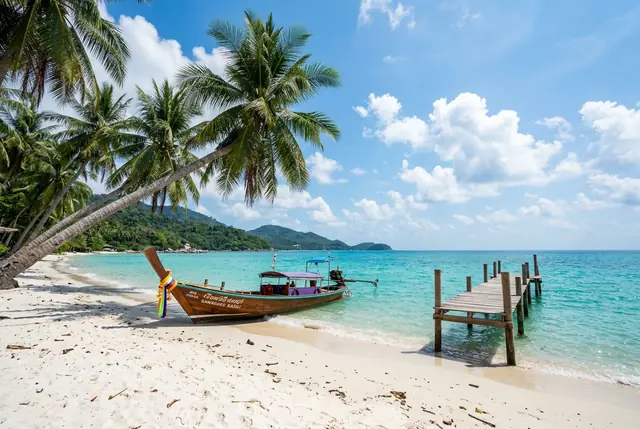
Round the bottom of the island, Samui stops being a resort. At Bang Kao and Thong Krut the sea turns into sand flats at low tide, the longtails for Koh Tan and Koh Madsum are moored off the pier, and the restaurants serve whatever came in that morning - with the Five Islands on the horizon and Wat Laem Sor ten minutes away. For: a boat morning and a seafood lunch, photographers, anyone who wants the island as it was. The honest downside: not a swimming coast at all - shallow for hundreds of metres over seagrass. Come here for the boats, the food and the view, not for a towel.
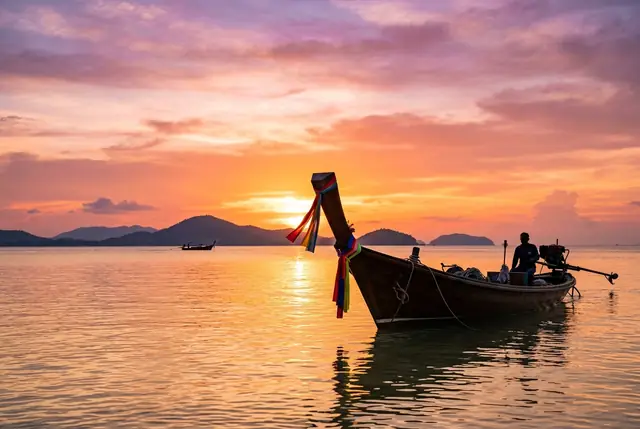
One thing the west and south own outright: the sunset. The east coast faces sunrise, so if watching the sun drop into the sea matters to you, either base yourself over here or plan an evening out - our sunset guide has the spots, and the sunset cruise (from ฿3,150, about five hours) solves it from the water, which is the version we'd pick.
The decision table
If you read one block on this page, make it this one.
| I want… | Go to… | Why |
|---|---|---|
| Nightlife and restaurants | Chaweng (Lamai on a budget) | The only two places with real choice after 9 pm, all walkable from the sand |
| Quiet, but not cut off | Maenam or Bophut | Long calm beaches with a real village behind them |
| Toddlers and young children | Choeng Mon, then Lipa Noi | Sheltered bays, warm shallow water, no shore break |
| Snorkeling | Coral Cove at high tide, then Silver Beach | Coral Cove's reef starts a few metres off the rocks; the real reefs are offshore |
| A sunset from my towel | Lipa Noi, Nathon, Taling Ngam | The west is the only coast that faces it |
| Seafood with my feet over the water | Bang Por, then Thong Krut | Stilt restaurants and fishing piers, where islanders eat rather than tourists |
| A tight budget | Lamai or Maenam | Same sea, noticeably cheaper rooms and food than Chaweng |
| Somewhere that still feels Thai | Bangrak, Thong Krut, Bang Kao | Fishing boats and local restaurants, no beach clubs |
The season changes the answer
This is what most beach lists leave out, and it matters more than any ranking. From late October to December, the north-east monsoon pushes wind and swell straight at the east coast: Chaweng and Lamai get churned brown water, a shore break that can be genuinely rough, drifts of seasonal seaweed on the sand and, some years, a few days of jellyfish warnings. It doesn't rain all day every day, but the sea often isn't the sea you booked.
On the same day, the west and south sit in the lee of the island: Lipa Noi, Nathon, Taling Ngam and Thong Krut can be glassy while Chaweng is unswimmable. Travelling in November or December? Base yourself west or south, or accept that a swim may mean crossing the island. From January to April it reverses - the east coast is at its calmest and clearest, the best beach months of the year (month-by-month guide). Tides work differently by coast too: the east barely moves, while Lipa Noi, Bophut and Bangrak retreat a long way out.
The beaches you can't drive to
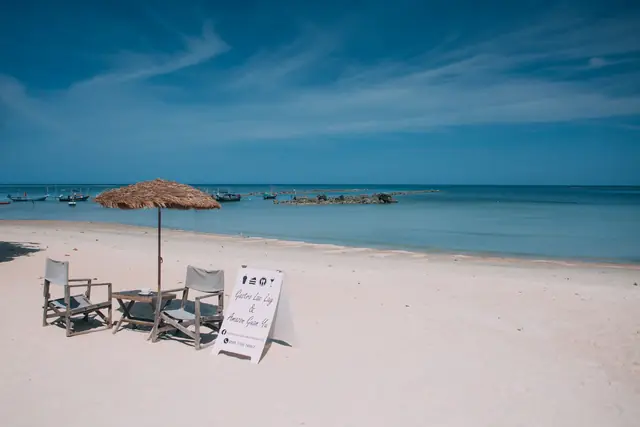
Honest conclusion after all of that: Samui's beaches are good, but the water people remember is offshore. Twenty minutes by boat off the south coast, Koh Madsum has the fine white sand and shallow turquoise water Samui itself never quite manages, plus the pigs that made it famous, and neighbouring Koh Tan holds the closest healthy coral to the island, which is why it's in our snorkeling guide. Further north, the 42 limestone islands of Ang Thong Marine Park are another landscape entirely: cliffs, a hidden emerald lagoon and viewpoints rather than swimming beaches.
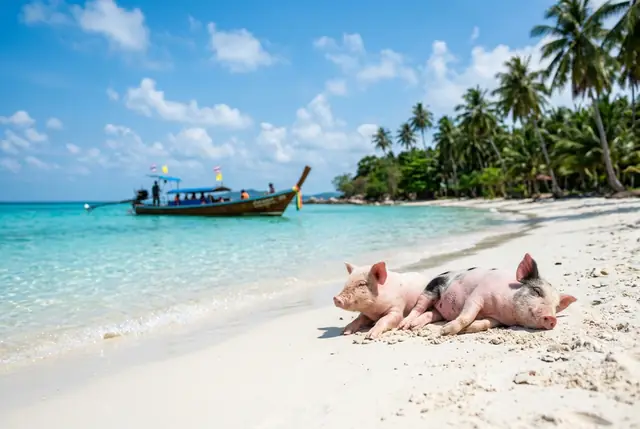
🏝️ The beach day no road reaches
Our Koh Madsum (Pig Island) & Koh Tan half-day is the shortest route to that water: 5 hours, snorkeling gear, buffet lunch and hotel pick-up included, from ฿1,388. Prefer landscape to sand? Ang Thong Marine Park starts at ฿4,085 for a 7-hour day in a group of 16 maximum.
See the Koh Madsum & Koh Tan tripBeach safety: flags, currents and what lives in the water
Samui's beaches look gentle, and most days they are. But every season we hear of swimmers who got into trouble on a day that looked fine from the sunbed, almost always on the east coast, almost always when the wind was up. A few habits cover nearly all of it.
- Read the flags, and believe them. On Chaweng and Lamai, a red flag means stay out of the water, not paddle carefully. Yellow means strong conditions; swim only where you can stand. Lifeguards are few and far between, so on most of the island the flag is the only warning you get.
- Know what a rip looks like. In the monsoon months a channel of darker, choppier water running straight out through the breaking waves is a current pulling seaward. If you are caught in one, do not swim against it: float, raise an arm, and swim parallel to the beach until it lets go, then come back in at an angle.
- Stay inside the buoys. Jet skis and longtail boats share the same water as you, and from a seat at speed a swimmer's head is very hard to see. Where swimming zones are marked, use them; where they are not, keep close to shore.
- Jellyfish are a seasonal fact, not a myth. When warnings are posted, take them seriously. If you are stung, rinse with vinegar rather than fresh water, do not rub the skin, and get medical help quickly if the pain spreads or breathing feels wrong - with children, go straight away.
- Respect the sun more than the sea. The midday sun this close to the equator burns in minutes, even under cloud. Shade from late morning to mid-afternoon, and a rash vest for small children, saves more holidays than any sunscreen.
The safest water on the island is also the calmest: Choeng Mon and Lipa Noi rarely produce surf, which is why they top our family recommendations. And if a strong swell has shut the east coast for the day, that is usually the day to go round to the west, or to swap the beach for a boat in sheltered water. The emergency numbers and clinic advice are on our travel information page.
Beach etiquette, and what to bring
Thai beaches are relaxed, but they are not lawless, and a few unwritten rules make the difference between being welcome and being tolerated.
- The sand is public, the sunbeds are not. You can lay a towel anywhere on any beach. The loungers and umbrellas in front of a resort belong to its guests, or are rented by the day; ask before you sit.
- Swimwear stays on the beach. Topless sunbathing is not part of Thai culture and is frowned upon even where nobody says anything. Throw a shirt on before you walk into a shop, a restaurant or the village street behind the sand.
- Leave the shells and the coral where they are. Taking coral out of Thailand is illegal, and on a reef like Coral Cove every hand placed on the rock damages something alive. Look, don't touch, and don't stand on it.
- Take your rubbish home. Bins are scarce on the quieter beaches, and what is left on the sand ends up in the sea within a day or two of the next storm.
For the bag itself, the list is short and specific to this island. Reef shoes for Coral Cove and for any north-coast beach at low tide, where the flats hide shells and sharp stones. A mask of your own if you plan to snorkel off the rocks - rental masks rarely fit. Reef-safe sunscreen, a hat and more water than you think. A dry bag if you might end up on a longtail. And small notes in cash: beach vendors, sunbed rentals and the seafood shacks at the quiet end of the island do not take cards.
If the reef is what you came for, our snorkeling guide has the spots where a mask is really worth packing, and the Koh Madsum & Koh Tan trip supplies the gear so you can leave yours at home.
Book it online
Koh Madsum (Pig Island) & Koh Tan
The easiest half day at sea: the pigs on the beach at Koh Madsum, shallow calm snorkelling off Koh Tan, buffet lunch. Our pick when time is short or the kids are small. from ฿1,388 / person
See availability on GetYourGuide →Read our review
Booked through our partner GetYourGuide: live availability, instant confirmation.
Our honest recommendation
If you want one answer: for a first trip of a week or less, stay in Bophut or Choeng Mon. Calm water, an evening on foot, a short airport run, and Chaweng only 15–20 minutes away when you want noise. Choose Chaweng instead if going out is a real part of the trip, Lamai or Maenam if the budget is deciding, Taling Ngam or Lipa Noi if you have a car and prefer sunsets to restaurants.
And whatever you pick, don't build the whole trip around your beach. Samui's beaches are a comfortable base, not a destination in themselves - the best water in this archipelago is a boat ride away, and it's reachable from every one of them.