Every autumn the same message arrives on our WhatsApp, in every language: we have booked for November, is it going to rain the whole time? The honest answer is no, but November is a real monsoon month, and a trip planned around four boat days will be disappointed. A trip planned around the island itself will not. This is how the wet season on Koh Samui actually behaves, what it cancels, and what we do with a grey day.
When it rains, and how much
Samui runs on the Gulf of Thailand calendar, not Phuket's. While the Andaman coast gets its monsoon from May to October, Samui stays mostly dry, and its own rainy season arrives later and shorter, carried by the north-east wind from October to mid-December. Here is what the long-term averages look like on the north-east coast:
| Month | Average rain | What it feels like | Boat days |
|---|---|---|---|
| October | 268 mm | Heavy bursts, often in the afternoon, then sun and steam. Most mornings are usable. | Mostly running |
| November | 434 mm | The real monsoon: grey spells of two or three days, wind on the east coast, rough sea. | Frequently cancelled |
| December | 200 mm | Wet first half, then the rain fades around mid-month and the high season arrives. | Back from mid-month |
Two things those numbers hide. Rain here rarely falls as a gentle all-day drizzle: it comes as loud, warm downpours of twenty minutes to a few hours, and the temperature barely moves, still around 27 to 30 °C. And the sea matters more than the sky: a dry but windy day in November can cancel a boat that a rainy but calm day in October would not. Our month-by-month guide has the full year, if you are still choosing your dates.
What the rain cancels, and what it does not
Ang Thong usually closes in November. The marine park shuts its waters to visitors when the sea is at its worst, and the long open-water run there is exactly what the north-east wind makes unpleasant. If Ang Thong is the reason for your trip, do not come in November; our Ang Thong guide explains when it reopens.
Koh Tao is a maybe. The ferries and speedboats keep sailing on most days, but the crossing gets rough, visibility on the reefs drops, and a few days a month are cancelled outright. People who get seasick should not pick this month to find out.
The short hops often still work. Koh Madsum and Koh Tan sit a few kilometres off the south coast, and the run out stays close to shore. They are the boat trips most likely to go ahead in a wet month, which is worth knowing when you pick your day trip.
Our rule is the same all year: every sea trip is confirmed the evening before, weather permitting, and if we cancel for the weather you choose between another date and a full refund. The practical advice is to book any boat day early in your stay, so that a cancelled Tuesday can become a Thursday instead of nothing.
Seven things that work in the rain
1. A Thai cooking class
The rainy day activity we recommend first, because the rain is irrelevant to it. Four hours with a Samui family, a walk through the market to learn what the herbs actually are, and four dishes you cook and eat yourself. It runs under a roof whatever the sky does: Thai cooking class with a Samui family.
2. The temples, inside and out
Temple halls are made for this weather: cool, quiet, and full of murals nobody looks at on a sunny day. The southern temples are the best wet-day route on the island, five stops in twenty kilometres with no entrance fee, and the mummified monk of Wat Khunaram sits in his glass case whatever the forecast. Our guide to the southern temples has the route; if you would rather be driven, the southern temples loop does it in a morning.

3. The waterfalls, the morning after
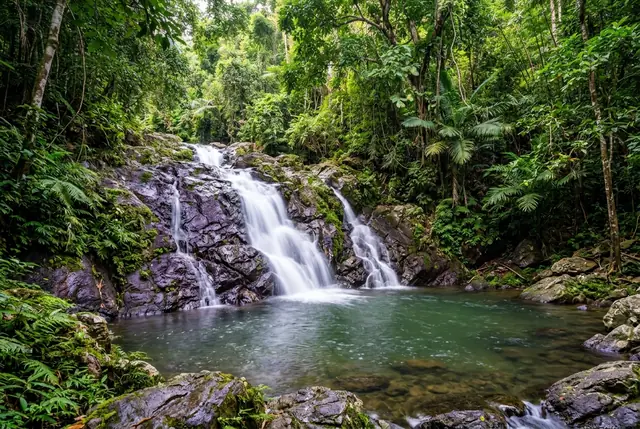
This is the one thing the wet season does better than the dry one. From October to January the rivers run and Na Muang 1 pours eighteen metres over its purple rock into a pool worth swimming in; by April it can be a trickle. The rule is to go the morning after heavy rain, not during it: the paths are slippery and the water rises fast. Our waterfalls guide ranks them, and waterfalls and zipline is a half-day we schedule for exactly these months.
4. Muay Thai at Phetch Buncha
An evening under a roof with a live band, a full card of fights and a crowd that follows every point. Phetch Buncha has cards on Monday, Wednesday and Saturday, and tickets start at ฿1,500 through our Muay Thai stadium page. Rain outside only makes it louder.
5. An elephant sanctuary
The elephants do not mind the rain and neither, after ten minutes, will you: bring a light rain jacket rather than an umbrella. The sanctuary we work with has no riding and no shows, and visitors watch from a raised walkway. Before choosing any camp, read our guide to ethical elephant sanctuaries.
6. The markets
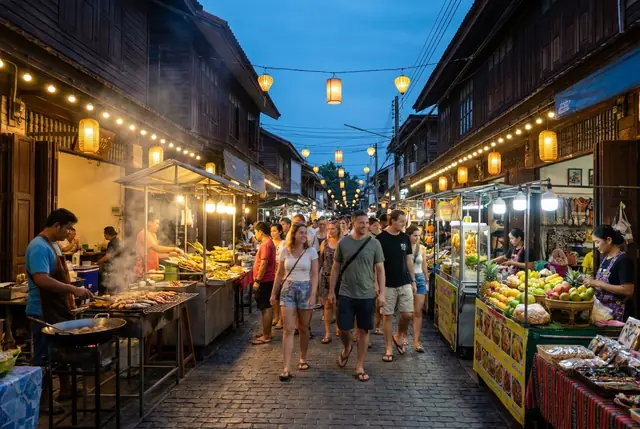
Morning markets are covered and busiest when nobody can go to the beach: fish, curries by the bag, fruit you have never seen. Evening walking streets are more exposed, a downpour at seven can empty Fisherman's Village in minutes and refill it by eight. Keep a flexible evening, and check the night market calendar for the day.
7. A massage, a long lunch, a slow afternoon
The least exciting advice and the most followed. Massage huts all over the island take walk-ins in cash, and a two-hour Thai lunch in a shophouse restaurant while the rain hammers the tin roof is a very Samui way to spend an afternoon.
What we would not do in the rain
- Ride a rented scooter up a hill road. The steep concrete climbs to the viewpoints turn slick in minutes, and wet-season scooter falls fill the island's clinics every week. Our guide to the viewpoints and the roads up says which ones need a 4×4.
- Drive the interior tracks after a storm. The roads to Khun Si waterfall and the Secret Buddha Garden are rough in the dry season and worse in the wet one. Go with a driver or wait for a dry day.
- Swim under a red flag. The north-east wind builds a shore break on Chaweng and Lamai from November into January. Lipa Noi and the west coast stay flatter, as we explain in Nathon and the west coast.
- Plan a snorkelling holiday. Visibility drops everywhere. Keep the reef for another trip, or for a calm morning if one comes.
Is the rainy season worth booking?
October and the second half of December, yes, without hesitation: lower prices in October, fewer people, green hills and full waterfalls, and most days still have long dry stretches. November is a different trip. If the sea is the point, go elsewhere or come in February. If you want the island, its food, its temples and a few quiet beaches, and you are happy to read a book while it pours, November is the cheapest and emptiest Samui you will ever see. Our budget guide shows what the low season saves.
A grey morning? Ask us what is running
Send us a WhatsApp in the morning with where you are staying: we will tell you honestly which boats are sailing, which roads are fine, and what we would do with the day. No booking needed to ask.
Contact us