Here is the unglamorous truth about eating on Koh Samui: the best meals on this island cost ฿60 to ฿150 and are cooked in front of you on a folding table, while the worst cost ten times that and arrive under a cloche in a resort dining room. The catch is that Samui's street food moves around - each town has its own evening, and turning up at the right market on the wrong night is the classic first-week mistake. Here is the calendar, the order list, the hygiene rules and an honest price comparison.
The night market calendar, evening by evening
One date is fixed and has been for years: Fisherman's Village Walking Street, in Bophut, runs on Friday evening, roughly 5 pm to 11 pm. It is the island's flagship market and also its most touristy - go anyway, then use the rest of the week for the others. Everything below that first row shifts with the seasons and the occasional new organiser, so treat this as a planning grid and confirm the day locally.
| Evening | Market | Where | What you'll find |
|---|---|---|---|
| Friday | Fisherman's Village Walking Street | Bophut, north coast | The flagship: wooden shophouses, seafood grills, cocktails, crafts, live music. Busiest and most polished. |
| Most evenings | Chaweng night market and Beach Road stalls | Chaweng, east coast | Handy if you sleep in Chaweng: cheap Thai plates, grills, fruit shakes, open late. |
| Most evenings, bigger one night a week | Lamai night market | Lamai, south-east | Locals and long-stayers. Fewer souvenirs, more actual food, our pick for value. |
| Generally Saturday - check locally | Nathon walking street | Nathon, west coast | The ferry town's own market, on a seafront facing the sunset. Very few tourists. |
| Generally Thursday - check locally | Maenam walking street | Maenam, north coast | Small, relaxed, village-scale. Easy with kids, easy to park. |
| Every morning | Local food markets (Hua Thanon, Laem Din, Nathon) | Around the island | Not dinner - this is where the island shops: dawn fish, curries by the bag, fruit. |
Three rules apply everywhere. Bring cash in small notes, almost nothing takes cards. Come between 6 and 7.30 pm to eat: after 8 pm the queues lengthen and the best grills sell out. And go early with young children, before the crush, which is why markets turn up in both our top 10 things to do on Samui and our family guide.
Fisherman's Village, Bophut - the best base for an evening
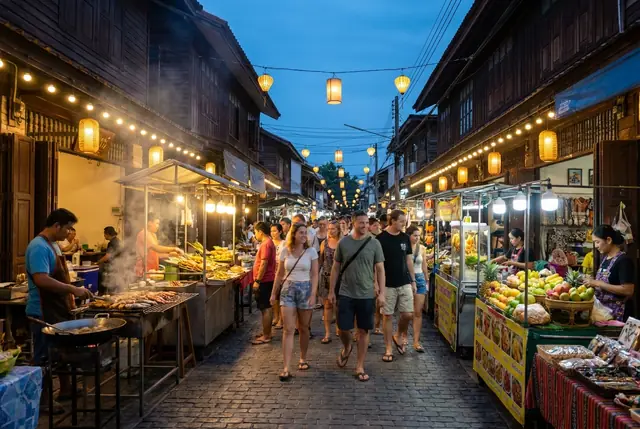
Fisherman's Village is a short strip of century-old Chinese-Thai wooden shophouses along the Bophut seafront, on the north coast. On Friday the lane closes to traffic and becomes the Walking Street; the other six evenings it is arguably nicer - a quiet street of restaurants, wine bars and small boutiques, with tables almost on the sand at the seaward end and the lights of Koh Phangan across the strait.
That double life is why we send people here first. Arrive at 6 pm, walk the street in twenty minutes, eat standing up at three or four stalls, then sit down for a beer facing the water without moving the car. It is also the softest landing for a first night in Thailand: English everywhere, prices displayed, nobody dragging you inside. Not the cheapest market on the island, that would be Lamai, but the most enjoyable place to spend three hours. Bophut is also one of Samui's calmest swimming beaches, as we explain in our guide to the island's beaches.
What to order at a stall
Ignore the laminated tourist menu and eat what the stall is built around - one dish, done a thousand times a week. The prices below are indicative market ranges; a beachfront terrace charges two to three times more for the same plate.
- Pad thai (฿60–100) - rice noodles fried to order with egg, tofu or prawn, tamarind and crushed peanuts. Good-stall test: it hits the wok in front of you, not a warming tray.
- Som tam (฿50–90) - green papaya pounded with lime, garlic, palm sugar, dried shrimp and chilli. Negotiate the chilli out loud: hold up fingers and say the number, or ask for mai phet (not spicy). One chilli is already assertive, three is a Thai lunch. New to Thailand? Ask for it without fermented crab.
- Moo ping (฿10–20 a skewer) - coconut-marinated grilled pork. Buy three, add a bag of sticky rice for ฿10–20, and you have the island's best snack for nothing.
- Khao man gai (฿50–80) - poached chicken over rice cooked in its own stock, with a ginger-soy-chilli sauce that carries the dish. Mild by default: the safe bet for cautious eaters and children.
- Salt-crusted grilled fish, pla pao (฿250–500) - a whole fish packed in coarse salt and lemongrass, grilled slowly, sold by size or by weight. Ask the price before it goes on the fire. Plenty for two.
- Mango sticky rice (฿60–120) - ripe mango, warm coconut-sweetened sticky rice. At its best from March to June, when the mangoes are local and ridiculous.
- Roti (฿40–80) - pan-fried dough with banana and condensed milk, folded and chopped with a spatula. Nobody has ever regretted one.
Eating street food without getting sick
Hundreds of market meals in, our bad nights fit on one hand, and all of them were avoidable. Street food is not the risk; stationary food is.
- Follow the turnover, not the tidiness. A stall with a line of Thai customers cooks through its ingredients within the hour. A spotless, empty one has held the same pot since noon.
- Cooked to order beats displayed. A wok, grill or fryer working in front of you is what you want. Lukewarm curry trays sitting under a bulb are what you skip, unless a queue is visibly emptying them.
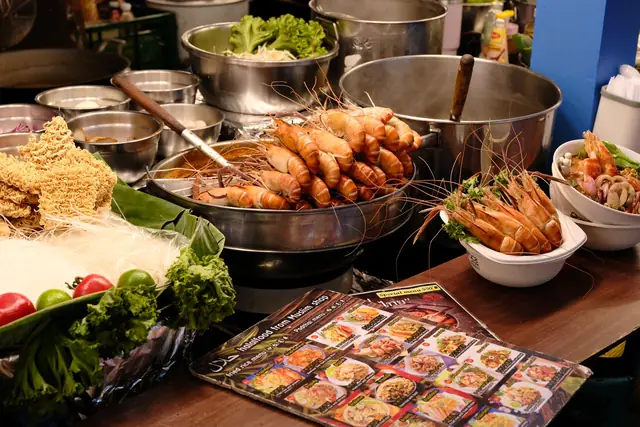
- Be wary of pre-shelled seafood. Peeled prawns, shucked shellfish and picked crab meat laid out in 32 °C air are the one item we systematically pass on. Whole fish and shell-on prawns straight onto the grill are another story.
- Ice is usually fine. Commercial tube ice, the cylinders with a hole through the middle, is made from treated water and is what most stalls use. Loose crushed ice of unclear origin, melting in a cooler at the back, is the one to decline.
- Ease in. Day one is not the evening for raw or fermented anything. Give yourself two or three days of grilled and fried first.
Allergies, vegetarians and the words that help
Thai market food is cooked to order, which is good news if you have a dietary need: most cooks are happy to leave something out. The difficulty is knowing what is hidden in a dish in the first place.
- Peanuts are crushed over pad thai and pounded into som tam, and peanut oil or peanut sauce turns up in grills and satay. Ask for mai sai thua, no peanuts.
- Shellfish hides in plain sight: dried shrimp in som tam, shrimp paste in curry pastes and dips. Mai sai kung means no shrimp, but a paste already in the curry cannot be taken out.
- Fish sauce, nam pla, seasons almost everything savoury. Vegetarians should know it is in dishes that look entirely vegetable.
- Gluten comes with soy sauce and oyster sauce, both standard in stir-fries. Plain grilled meat or fish, sticky rice and fresh fruit are the safest ground.
For vegetarians, two words matter. Mangsawirat means vegetarian. Jay is the stricter Buddhist and Chinese tradition: no meat, no fish, no animal products and traditionally no garlic or onion either. Stalls flying a small yellow flag with red lettering are serving jay food, and they are the easiest place for a vegan to eat without negotiating anything.
Pronunciation is the weak point of any phrase list, so do what the regulars do: ask your hotel reception to write your allergy in Thai, take a photo of it and show the screen when you order. It removes all ambiguity, and cooks appreciate it.
One honest limit. A market stall shares one wok, one board and one oil between dozens of dishes, and nobody can promise you a trace-free plate. If your allergy is severe, carry your medication, keep to dishes that are simply grilled in front of you, and favour sit-down local restaurants on the first evenings. Travelling with a child who has an allergy? Our family guide covers eating out with kids more broadly.
Market manners, and five words worth learning
Thai night markets run on a few unwritten rules. Nobody will scold you for missing them, but knowing them makes the evening smoother, and it is noticed.
- Point, order, pay. At most stalls you order and pay on the spot, then wait to one side. If a stall has a few tables, you sit, order with the person who comes over, and pay at the end.
- Food prices are not haggled. The plate costs what it costs, and it is already very little. Bargaining belongs at the clothes and souvenir stalls, politely, and never over a few baht.
- Share the tables. Shared tables are normal: a nod to whoever is already sitting there is all it takes. Do not hold a whole table with bags while you queue elsewhere at the busiest moment.
- Carry your rubbish. Bins can be scarce, so take your skewers and cups with you until you find one. And you can refuse the extra plastic bag: mai ao thung, no bag, works everywhere.
- Small notes, always. A large note for a cheap skewer leaves a vendor without change for the rest of the evening.
Five words cover most of an evening. Tao rai? - how much? Ao an nee - I'll have this one, with a point. Phet nit noi - a little spicy, the middle ground between mai phet and a Thai lunch. Aroi - delicious, said to the cook, gets a smile every time. And khop khun, thank you, followed by khrap if you are a man and kha if you are a woman.
If you would rather be guided through your first market by someone who knows every stall, our night markets and street food evening does exactly that, and Koh Samui after dark tells you which market is on which night.
Book it online
Thai cooking class with a Samui family
Herbs and ingredients picked out at Big Buddha Market, then four Thai dishes cooked from the paste up in a family kitchen, and eaten. Rated 5/5 by 538 travellers. from ฿2,500 / person
See availability on GetYourGuide →Read our review
Booked through our partner GetYourGuide: live availability, instant confirmation.
What a meal actually costs
This is where the gap turns absurd. Orders of magnitude for two people, one main each plus a drink, as we see them in mid-2026 - indications, not quotes.
| Where you eat | Per dish | Dinner for two |
|---|---|---|
| Market stall or street cart | ฿50–120 | ฿300–500 |
| Local Thai restaurant (shophouse, plastic chairs) | ฿90–200 | ฿500–900 |
| Tourist restaurant on the beach | ฿250–500 | ฿1,200–2,200 |
| Resort or hotel restaurant | ฿400–900 | ฿2,500–4,500 |
Two things inflate the bottom rows: service and VAT are usually added at the higher end, and imported wine carries a tax that can cost more than the meal itself. For a two-week stay, eat at markets and local restaurants most nights and put the difference into one genuinely great dinner.
Dinner with a view
Samui has two kinds of view table: sand level and ridge level. On the sand, Bophut, Maenam and the west coast around Lipa Noi and Taling Ngam put tables where the water arrives - and the west is the only side where the sun sets into the sea, which we map in our guide to the best sunsets on Koh Samui. On the ridges above Chaweng, Lamai and Nathon sit a handful of viewpoint restaurants looking down over the coconut canopy.
We deliberately name no addresses. Hilltop places here change hands, names and standards faster than any article can track. What holds: book the ridge tables for sunset rather than after dark, expect a steep access road that a scooter with two adults will not enjoy, and if you want the current shortlist, ask us on WhatsApp.
Sunset first, dinner second
The best evening we know on Samui costs less than one resort dinner. Our sunset cruise picks you up at your hotel, sails a restored wooden trawler along the coast, stops for a swim in a quiet bay and brings the sun down over the water - about five hours door to door. Do it on a Friday and the Walking Street at Fisherman's Village is still in full swing when you get back.

Sunset cruise, then Friday night at Fisherman's Village
About five hours with hotel transfers on a restored wooden trawler: beanbags on the roof, a swim stop in a calm bay, the sunset on deck - from ฿3,150 per person, booked through our partner GetYourGuide.
From the boat to the plate
If you would rather earn your dinner, our traditional fishing evening (from ฿1,650, 4 pm – 8 pm) goes out with Samui fishermen: line fishing as the sun drops, lamplight squid fishing after dark, and your own catch grilled on board with rice and homemade sauces. The same food you would queue for at the market - minus the queue, plus the part where you caught it.

Getting home is the part people forget: songthaews thin out after 9 pm and evening taxi fares are a negotiation, so agree the price before you get in, our guide to getting around Koh Samui has the current rates. If you are four or more, a private transfer from ฿440 works out cheaper per head than a taxi. And if dinner is only the start of the evening, Koh Samui after dark has the rest of the week: Muay Thai, fire shows and the evening boats.